Co-Author • The Strategic Influence of Sustainable Supply Chain Elements on Profitability in Beverage Manufacturing Companies, Advances in Consumer Research
I examined how eco-friendly sourcing, packaging, and waste reduction contribute to long-term business performance and operational efficiency.

Abstract
Sustainable supply chain management (SSCM) has become an essential driver of profitability in beverage manufacturing, where high resource consumption and competitive market pressures demand efficiency and innovation. This research analyzes the strategic influence of sustainable supply chain (SSC) elements on profitability in beverage manufacturing companies. The objective is to determine how sustainable procurement, eco-friendly production practices, efficient distribution systems, and reverse logistics contribute to profitability indicators such as cost savings, return on investment, and revenue growth. Data are obtained from 112 managers and supply chain personnel in beverage manufacturing firms, with 78% valid responses. Analytical methods included regression and correlation analysis using IBM SPSS software version 26 to test the relationships between the variables. The outcomes indicate that eco-friendly production was the most influential predictor of sustainable procurement (β = 0.198,p = 0.003), profitability (β = 0.241,p = 0.001), followed by reverse logistics (β = 0.143,p = 0.037), and efficient distribution (β = 0.182,p = 0.005). Profitability refers to the financial performance of beverage manufacturing firms, measured through cost savings, return on investment, and revenue growth. The results highlight that embedding sustainability across supply chain operations substantially enhances financial performance, making it a strategic imperative for beverage manufacturers seeking long-term growth and competitive advantage.
Keywords
Profitability Green Procurement Beverage Manufacturing Sustainable Supply Chain Operational Efficiency

Assessing the Potential Socio-Economic Impacts of High-Speed Railway Projects in Vietnam
I analyzed the socio-economic impacts of Vietnam’s North–South High-Speed Rail and proposed data-driven policy recommendations for sustainable investment.
Abstract
This paper investigates the potential socioeconomic impacts and the strategic feasibility of development strategies for the North–South High-Speed Rail (HSR) project in Vietnam. Using a sociological survey of 250 respondents through a 50-item Likert-scale questionnaire and a SWOT-based quantitative analysis, the study quantifies the short- and long-term economic benefits, social equity dimensions, perceived risks, and strategic pathways for implementing the project. Descriptive statistics, reliability testing, factor analysis, and correlation analysis support the findings. Results show strong positive expectations regarding economic connectivity and regional balance but also reveal significant concerns over financial burden, institutional capacity, and environmental uncertainties. The paper recommends phased investment strategies, a transparent PPP institutional framework, and the establishment of an inter-ministerial steering committee to maximize the project’s effectiveness.
Keywords
High-Speed Rail Socioeconomic Impacts SWOT North–South Corridor Investment Strategy Vietnam
Author • From Motorbikes to Metro: How Urban Rail Transit Transforms Street-Level Economic Activity in Asian Cities
I authored an ongoing research paper comparing how urban rail systems in Tokyo, Singapore, and Hanoi integrate with street-level retail, blending expert interviews across three countries with primary fieldwork to reveal transit-driven economic shifts in Asian cities.

Abstract
This study examines how urban rail transit reshapes street-level commerce through comparative retail integration in Tokyo Metro and Singapore MRT. In-depth interviews with 10+ transit executives, economists, and operators across Japan, Singapore, and Vietnam reveal revenue models yielding 2.5–3.8 times higher station retail density than traditional streets. Field research on Hanoi Metro Line 2A (100+ commuter surveys, 5-station foot traffic counts) shows station retail revenue per m² averaging 38% of Tokyo benchmarks, with 62% of surveyed vendors reporting displacement pressure. A 22-page policy paper recommends zoned leasing, micro-franchise incentives, and digital payment integration for Vietnam Metro Corporation’s 2025–2030 strategy, enabling scalable expansion of the ANTEA commuter-focused franchise from one to eight stations by 2028.
Keywords
urban rail transit retail integration, economic spillover street vendor displacement revenue benchmarking Hanoi Metro Tokyo Metro Singapore MRT.
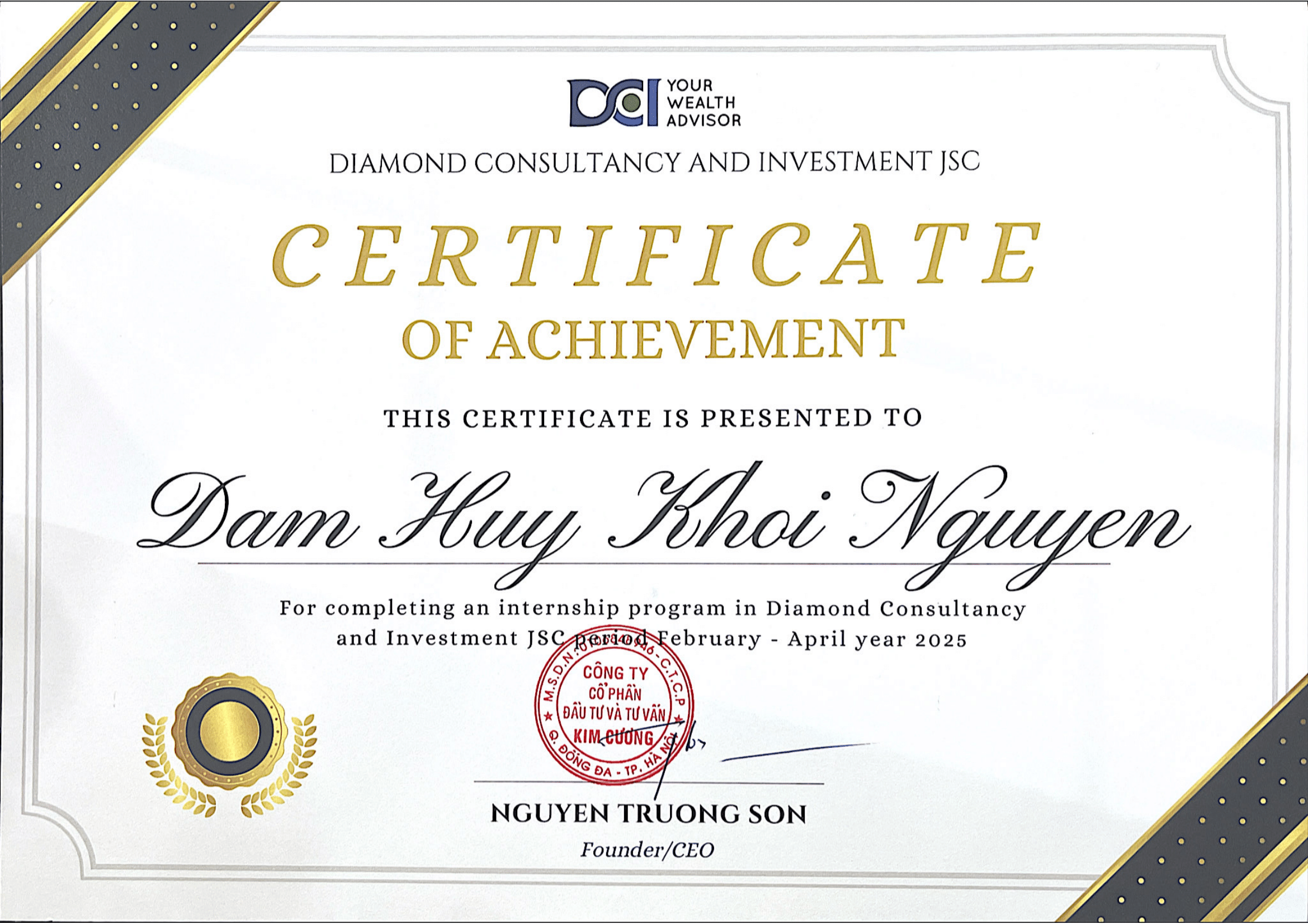
INTERNSHIP
Gaining hands-on experience at DCI Vietnam Consultancy and Construction Investment JSC, I applied financial analysis and investment evaluation skills to real projects, learning how data-driven insights guide strategic business decisions.
HONORS AND AWARDS
Gold Medal, World Invention Creativity Olympic & Conference, 2025
Gold Medal – Vietnam Computational Linguistics Olympiad, 2025
Representative of Vietnam at International Linguistics Olympiad, 2025
Gold Medal, The 11th HongKong International Music Festival, 2024
Gold Medal, Youth Friendship Festival in Indonesia, 2024
Silver Medal, Rising Stars International Arts Festival & Competition, 2023
Gold Medal, Yoshine Music Festival, 2022
Silver Medal, Youth Friendship Festival, 2022
Honor mentioned, Scratch Olympiad, 2020